Yes, it's finally happened. In the vain pursuit of bumping my readership numbers, I have finally sunk to the absolute bottom of clickbaity blog titles. Am I ashamed? Absolutely. Did it stop me? Nearly. But, here we are... I pressed publish and now it's all a bit late!
 |
So, "WHY IS EVERYONE BLACK ALL OF A SUDDEN?"
|
I've been asked the question about twice of late.
"Who are you hanging round with? The EDL?"
"Definitely not. I can't even spell DLE."
Actually, both times that I have been asked this question, the person doing the asking was a person I really quite like: someone intelligent, someone inviting inquiry and conversation. Perhaps I should also note: both of the people that asked me were white (I think you could pretty much work that out from the question) but let's not hold that against them!
Honestly, it's a reasonable question in the sense that all questions are reasonable, providing you're truthfully seeking an answer. Maybe you've also heard someone ask something similar?
In truth, I've actually been asked this question (or something like it) three times of late, but one of those times was markedly different in tone. In fact it serves as a great example of the dangers of making certain questions taboo... but I'll be coming back to that at the end.
All in all "Why is everyone black all of a sudden" has been a popular conversation starter. Perhaps in response to a few cross-colour casting decisions reported about in the media, perhaps because I keep boring the arses of people by talking about my research into arts and identity and they've run out of other things to say.
Whatever the reason, before we espouse an opion about "why everyone's back all of a sudden," I feel it's incumbent on me to point out:
- It isn't true
- It doesn't make sense
- It is slightly morally dubious
"WHAT DO YOU MEAN IT ISN'T TRUE?!
What about Snow White?
Elphaba?
Severus Snape?"
"Well... they're all interesting examples of something
(three different somethings actually).
But none of them are examples of
EVERYONE
BEING BLACK
ALL OF A SUDDEN."
Let's start with defining our terms:
1. Who do you mean by everyone?
- Everyone in the world? (surely there's about the same black people as yesterday, and as there will be tomorrow, birthrates notwithstanding)
- Everyone in Britain? (Actually 85% of the UK population are white... though that is changing, faster in some places than others)
- Everyone in entertainment? (Even that seems like unrepentant hyperbole... I mean, I can't say for certain, but I'm pretty certain I've seen white people in a couple of things recently... by which I mean everything. Chill out!)
2, What do we mean by black?
- I don't want to get too woke on everyone here, but it's always worth pointing out that terms like white and black are technically incorrect because technically everyone's brown. I know I'm obviating the more important issues relating to culture and identity, but it's always useful to have in the back of your mind the thought that there is actually only one skin pigment in humans: melanin. You either have a lot of it, a little of it, or somewhere in between. Being white means really just being very very light brown, and being black means being darker brown than that. It really wasn't that long ago before everyone's ancestors lived in Africa and were all as brown as each other
- The identification of someone as being black, implicitly contrasts them against a cultural norm of being white. In fact, having a racial identity at all only has any meaning in a multicultural setting. Within such a context: who are you identifying as black? Someone with black (ie dark brown) skin from the African diaspora, or do you simply mean anybody who does not adhere to the cultural norm? i.e. for the purposes of your question: are Indians black? Are biracial people black? Are Jews black?
3. What do you mean, all of a sudden?
- In reality, I'm probably asking how old you are. The younger you are (and the closer you live to an urban centre), the higher the percentage of you lifespan you will have spent living in a multicultural country. Granted, this isn't true across the board... demographics are tricky things to generalise about and there are plenty of places in the UK where seeing a person from the global majority would be something of a talking point in the village. You'd have to be knocking on a bit to remember the peculiarly white Britain that predated post-war immigration, but if that's you, you have witnessed a hell of a demographic shift - that is true. However if, like me, you're somewhere in the middle, you might have noticed a few more non-white faces than you did 40 years ago, but if you've spent 40 years counting how many non-white faces you see everyday, you're probably not the kind of person that's going to enjoy this blog. TTFN.
To give you an idea of how big an demographic shift you are likely to have noticed, here's an
interesting graph from Wikipedia showing how the proportion of white people in the UK population has changed over time.
I was born in 1981 (I've got love for you if you were born in the 80s. Love, but no milk... thanks, Thatcher!) That means, in my lifetime the UK has gone from being 94% white to being 82% white. From my perspective, I have noticed the UK become noticably less white over my lifetime. But the key words here are over my lifetime... not, as the question implies: all of a sudden.
Now that we've more clearly defined our terms, let's answer the question that I was actually being asked:
"Why am I seeing more non-white performers in entertainment than I used to?"
Well, that is a very different question, and a very good one too. It is a question to which there are interesting and contested answers (NB plural, because there are several)... and in answering it, we shall also cast light on the magical world of pantomime.
So, first things first...
??? HOW DIVERSE IS ENTERTAINMENT ???
It's a good question, and it is surprisingly difficult to get a definite and up to date answer. There's a lot of research in the public domain in the last decade, but I can't find a lot in the last 12 months.
BFI diversity standards for film stipulate that at least one of the main characters should be from an under-represented group. This could be defined by race, or disability, or sex or sexuality. For secondary characters, film makers must hit at least one of a range of diversity targets, one of which is 40% ethnic diversity (London) and 30% ethnic diversity (rest of UK).
"Is that a lot?"
"Well, for London, no."
According to the
2021 census, 46.2% of the population of London are from Asian, Black, Mixed or Other (non-white) ethnic groups, with another 17% being from other white minority groups. When compared to the 63% 'minority' ethnic profile of London, the BFI's 40% target seems timid.
If you don't live in London, 30% might be overegging it somewhat: regions like North East and Wales are over 90% white, and most of this diversity is in urban areas. There are plenty of people who don't get out much who go around thinking Britain is whiter than the French war flag. (Can I make a joke about the French? Is that racist, or is that still OK because they're European?)
How about diversity on TV?
Well, here's where my data gets a lot worse. The best source I could easily found is
this Ofcom monitoring report from 2018. In 2018, Ofcom found that 12.5% of the TV population was from ethnic minorities (or if you prefer, the global majority... plus non-majority white races, unless you already counted them... terms are confusing). This was comparable to the 13.7% of the UK population in these demographic groups in 2017. Black people from the African and Caribbean diasporas were over represented (roughly double) and South Asian people were under represented (roughly by half)... which is interesting!
Particularly for panto... we will get onto this later too!
Now... 2018 was a long time ago (particularly in the world of on-screen diversity monitoring). Since then we've had a PM with Indian heritage, non-white winners of Britain's Got Talent, and an orange man ruining the United States. I think (and this is my own hunch) there probably has been some further shift towards greater representation of minority ethnic groups on UK TV since then... I defo don't think we've gone backwards, so I think we can safely assume peeps on-the-whole are well represented - perhaps with a caveat that we would like to see more Asians.
"WHAT ABOUT THEATRE?!"
??? WHAT ABOUT THEATRE ???
Who's measuring this data? Is anyone? I don't know... they certainly aren't publishing it in any of the places I've been looking at.
I can tell you that some roles are ring fenced for non-white actors.
 |
The awesome Little Shop at The Octagon, Bolton
If you haven't seen it yet... you're too late. They just passed by!
|
Also, the guy playing the plant was black, even though you couldn't see him till he came on and bowed, but you could hear him, and everybody expects the plant to do the voice off the film... and it would be weird for a white actor to put on a black voice. And also, the actor playing Mushnik was Jewish, because the character Mushnik is Jewish, and by this point you've probably already cut and paste "we welcome applications from ethnically diverse performers" from the other Spotlight callouts, so why change it now?
The fact that the cast and their performances were so fabulous is testament to the reputation and well-thought-out casting policies of the Bolton Octagon.
.... Particularly as they were all actor-musos.
.... from the Bolton area.
... And you thought your casting process was tough!
 |
Mushnik from the same production... who also played the drums!
|
Now, I've just mentioned half the cast. So unless you were black, or Jewish, and a puppeteer/musician or 3 young women singing close harmony, I'm sorry, those jobs weren't available to you. Nor do I think they should be (except perhaps Mushnik... I mean, it was great that he was Jewish, and he was absolutely awesome, but nobody buys a programme nowadays, so if you were stuck you might be tempted to cast someone who merely look Jew-ish).
Now, the reciprocal is
not true. If you are from an ethic minority, there is nothing to stop you from auditioning for Seymour or Audrey if that's what you want. Heck, if you fancied your chances, you could put in for
Anne Boylin or
Dr Who or even
Snow White.
"Snow White? Isn't that the one part
you should keep for white actors?"
"Well actually, Rachel Zegler's biracial.
Her father's from Poland...
or her father's father was...
well, somebody was at any rate,
and that means that Rachel's part Polish,
so unless you're advocating for Spotlight
to bring in a "one-drop" rule, she's surely white enough!"
"But the whole point is that
Snow White's skin is as white as snow."
"Nobody's skin is as white as snow."
"But lots of actors are whiter than her.
Aren't you taking away jobs from those actors?"
"No, because those other actors couldn't have played that part."
"Why not?"
"Because they're not Rachel Zegler,
the amazing award winning actress. It's a stunt casting."
"Don't you just hate that?"
"I do. But I'm not trying to recoup
millions of dollars of big movie budget.
At least it got everyone talking about it."
"Kind of backfired though, didn't it?"
"Yes. It did this time."
"Because people prefer white actors in "white roles"?"
"Some very few perhaps:
Tommy Robinson, Marjorie Taylor-Green.
I think mostly it backfired because
people hate cynical movie producers stunt casting actors
just to meme-stoke culture-war controversies."
"You said she got cast because she was amazing."
"I don't know. I didn't actually see it."
"What about Paapa Essiedu who's just been cast as Snape? Was that a stunt casting?"
"I don't know, I'm only writing a blog.
But I think there was a whisper of that in some corners."
"You coward! What's the point of writing this blog if you don't proffer an opinion!"
"Alright!
I never imagined Severus Snape as black.
He's not black in the books.
Or in the films. And I do love the films.
(Yes, you can judge me in the comments:
but if anyone doxes me...!!!!).
Therefore it was a surprise to find out
that Papa was playing him.
Lots of people were surprised.
Surely, the producers would have expected that?
And when they cast him
they factored in that surprise as a saleable quality. If they didn't want a surprise,
they could have made some of the other characters black."
"Like who? Everyone in Harry Potter is white!"
"They're not all white.
Not in the books anyway, but I take your point.
The actress who played Hermione in the Cursed Child was black
- that worked -
I'd less firmly imagined that role to be white."
"But you did imagine it."
"Of course I imagined it...
that's what it says in the books."
"What about Wicked?"
"What about Wicked?"
"In the new film,
the actress they cast to play Elphaba is black,
but in the book Elphaba is green!"
"She's green in the film!"
"But in the original movie,
it's played by Margaret Hamilton.
And Margaret Hamilton's white...
she's just painted green."
"You do know they painted Cynthia Erivo green too."
"You can still tell she's black!
She has black facial features."
"I know.
She is black.
Acting is pretend.
Cynthia Erivo is a famous black actor
and not an actual witch."
"But she got cast because she is a black actor!"
"Maybe that was reason 11 or something.
Shortly behind 'BECAUSE SHE'S ABSOLUTELY FUCKING AMAZING,'
TEN TIMES!"
"What about all the famous white musical theatre actresses?"
"They were also cast in the film!
You had to have won two Emmy's
just to walk on as an extra!"
"Alright, forget about movies.
What about stage actors?
Do you remember that black actress who played Juliet last year?"
"You mean Francesca Amewudah-Rivers?"
"I don't know her name.
She played opposite Tom Holland as Romeo."
"Then you mean Francesca Amewudah-Rivers."
"She was black, but Juliet is supposed to be medieval Italian.
Why aren't they casting all medieval Italians?"
"Because somebody's got to be black!"
"WHY THOUGH?!
WHY CAN'T EVERYONE JUST BE WHITE?!"
"Because lots of British people are black!
Black British actors are actors...
they do acting...
they need roles to act in.
If you only cast white performers
to play every character that has
at some point been imagined as white,
you'd put every black actor on the dole.
Shakespeare - out!
Chekov - out!
Stage adaptations of TV classics:
Yes Minister, Fawlty Towers, Only Fools -
out, out, out!
90% of the British cultural canon predates post-war migration,
You can't rule people out of the art form
simply because their ancestors arrived on the island too late!"
END OF SCENE
WHY NOW?
What I can say, from my own experience, including attending the UKPA conference about diversity, and also including interviewing dozens of panto professionals. Everybody in pantoland is very aware of the need to cast for ethnic diversity.
If you intervieweprofessional panto producers you hear five basic arguments for why they are so keen on casting for ethinic diversity:
1. Maximising the pool of talent
2. Providing opportunities for marginalised groups,
3. Representation of the audience,
4. Vanguarding cultural diversity
5. THE SECRET EXTRA REASON THAT NOBODY'S TALKING ABOUT (PUBLICLY)
1. Maximising the pool of talent
Casting is hard. You have limited time to read profiles, watch showreels and pick people you'd like to come in person. Now there are A GIGANTIC NUMBER of HUGELY TALENTED, HARD WORKING actors out there, all of them worthy of being on stage, but you only get to pick one actor for each part, and you only get time to audition a few.
What you're aiming for with auditions is to select enough very talented actors, any of whom you could cast, and all who have something to offer.
a
 |
FUN FACT: Big Tiny auditions are like The Voice, ..
only the panel start off facing forwards,
and the chairs don't revolve and
also instead of pressing our buzzers, we print off the actors CVs and make notes.
|
In the midst of this melange of submissions, casting calls and auditions,:great performers get overlooked, or misplaced, or unfairly not-considered, not because they have done anything other than choose a profession that is hugely overcrowded. This is entirely unfair. And there is very little any producer can to rectify it.
Because...
... the very best way to make choices,
is to choose from the widest range of possible options.
There is no point seeing 10 six foot, blonde dancer-singers who all trained at Lanes if you need one Prince Charming. You'd like to see maybe the best two of those, maybe a couple of actors who sing, someone older, some grads, a couple of comedy character actresses in case you decide to go 'principal-boy'- and within those, every type of diversity. Not only ethnic diversity: disability, neurodiversity, LGBT. You want to wash up after auditions and make some artistic decisions about the cast and the show that you want to produce.
The better your processes, the more likely it is that you'll see the best people, and the cast you assemble will reflect the diversity of the talent pool that you managed to attract.
2. Providing opportunities for marginalised groups
IMHO, this is the weakest argument of the five. I have heard it proposed many times and I either don't agree that it is that big an issue, or I don't think it's what actually drives producers.
 |
Contrary to popular belief, the Lurpack Man is not part of a marginalised group
As he is made out of butter and not margarine |
Do I think people from ethnic minority backgrounds are marginalised in Britain? I do!
Do I think ethnic minority actors are marginalised in the Arts? I don't.*
*Well OK, I do if we're talking about Hollywood movies... or celebrity/stunt-casting/national-treasuring and the like. But that's the exception. If I were a black actor, right at the top of my game and the only thing stopping me breaking through was my ethnicity, yes, I'd be furious. And I would kick up a stink in the national press, and I would plaster it all over social media too. Rightfully so.
BUT, most actors aren't anywhere near that position. Only a blessed few ever get chosen, only the rarest ones taste that kind of fame. Most actors act for a living. And if they're really good, and work hard, and network, and keep up with training, they still have to be lucky to earn enough money to act for a living full time. Certainly this is the case for most actors we call.
If we consider just this group of actors: does being part of an ethnic minority mean you are marginalised in the industry? I would suggest: possibly not.
Before you start commenting underneath, hear me out (and bear in mind I'm not black nor an actor)... I think all actors are marginalised. I think the depersonalisation of industry practices, coupled with an oversupply of graduate training courses forces the average professional actor into the margins.
Every actor deserves care and professional consideration. The whole system is so desperately inadequate, that any special pleading for one particular group of actors becomes a bitter pill that others are asked to swallow. In my experience, and in the experience of people I have spoken to, when we consider the margins of this brutally competitive profession in which the average jobbing actor competes: being from ethically diverse backgrounds often means you are more likely to be called to audition, are more likely to be cast, and in some cases can also benefit from the ringfencing of non-white roles.
Now, does this mean that the system is broken? No. It just means that the argument that producers have a moral obligation to cast for ethnic diversity as a foil against marginalisation is weak. For a number of producers, the reasons for cast for ethnic diversity are something other than this.
3. Representation of the audience
This is a SUPER strong reason to aim for an ethnically diverse cast.
If I were watching a panto in London, or Leicester or any town in which every other face you see is not a white face, it would seem VERY STRANGE to me to see a cast in which everyone's white.
Who are you making the show for?
True: even in cosmopolitan boroughs white people are often over represented amongst theatre audiences compared to the local population. There are social, cultural and economic drivers at play, that I've covered at length in previous blogs. However, that ain't gonna change very quickly if every time someone who isn't white comes to see a show, they only see white people acting.
Britain is becoming more diverse. If theatre (and panto) is going to thrive, audiences need to become more diverse. And that means the casts need to be more diverse.
BUT HERE IS AN ABSOLUTELY MASSIVE CAVEAT...
This is not a homogenous process.
London isn't Wrexham, Birmingham isn't Barrow-in-Furness.
There are plenty of towns in which non-white faces are an exception. One of the pantomimes I produce is in a valley that was 98.5% white in the 2021 census. There are non-white people in the valley, there are non-white people in the audience, where inclusion and community are not only at the heart of our practice but that of the theatre. However, if the point of casting is to be representative - a representative cast in that valley would have one non-white actor every eight years.
There is a real pressure on panto productions to cast for ethnic diversity, felt at the same time of year, up and down the country. With the best will in the world, it is difficult to secure the best actors, within budget, who may have to relocate over Christmas. It is not practical to imagine that smaller, regional pantomimes will be able to access the same pool of talent as Crossroads or big city shows like the Hackney Empire.
Still, there persists from some corners, a clarion call for all casts to contain at least two non-white faces in order to be representative. Come as it may from a well-meaning place, I can't help but wonder if those people got out of their corner and traveled around the regions a bit, whether their clarion call would be a bit quieter!
12 miles away from our panto in the very friendly, overwhelmingly white rural valley of Saddleworth, we have another panto in Bury. Bury is very close to the cosmopolitan city of Manchester and is much more ethnically diverse. I
do feel a greater pressure to cast for ethnic diversity here, because I do want all my audience members to feel represented. We have cast some great black actors in Bury, who
have relocated from London, and given very successful performances - so casting was definitely a success. However, in Bury, the most populous ethnic group after White is South Asians, which includes 10 times as many people as Black (
see 2021 census here).
Ideally we'd like our cast to include northern actor-singers with South Asian heritage, that would be much closer
representation of the local population, but despite our best efforts we have found these actors scarcer in our submission pool. It is possibly that casting the panto in Bury is subject to similar cultural and arts-access barriers driving the disparity between Black and South Asian performers that Ofcom reported in 2018. That is a bold hypothesis that would have to be tested.
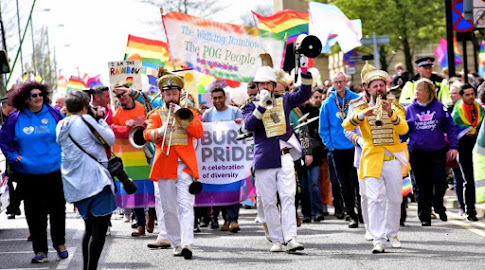
Above - The March for Diversity through Bury Town Centre, 2024
Pictured here, moments before catching up to then fatally trampling over a slow moving Beatles Tribute Act which had pulled out in front without signalling.
4. Vanguarding Cultural Diversity
This is another strong argument. Maybe the best one so far.
Vanguarding means taking action to get ahead of an issue before it turns into a problem.
In pantomime's case the issue is: it's a traditional art form, of which the traditional audience stopped having children to pass the tradition down to.
I know, I know! That was 3 unwarranted generalisations, tarted up to look like a sentence). On its own, this isn't a problem.
- There are actually lots of non-white families who go to the pantomime. There are even pantomimes aimed at ethnically diverse communities, e.g. the touring muslim panto which has a very South Asian bent.
- The start of post-war immigration was the best part of a century ago. When we talk about ethnically diverse audiences, we're not imagining people getting straight out of "small boats" and heading to box office to buy their tickets for Cinderella. Increasingly, we're talking about three or four generations of cultural harmonisation... plenty of time for a family to develop their own tradition of panto attendance. Which many families have.
- Increasingly, British families are themselves ethnically diverse. Say what you like about human beings, but the one thing they do love is other humans... and they don't let ethnicity get in the way. As more and more families inherit a mixture of traditions from diverse heritages, the less meaningful it will be to talk about "white" or "non-white" families. (The sooner the better, IMO)
- Lots of white families are having children. But not as many, on average, as previous generations.
The concession of these three apposite rebuttals notwithstanding, a great deal of pantomimes enduring popularity is borne of the fact that grandma came with her granny when she was a girl, and she buys the tickets for all of her littlies with the money she gets for her winter fuel payment (whoops!). The long and short of it is, that panto producers in 50 years will no longer cash in on such an economic boon.
Now, you may well posit: so what? Why should we care about panto producers. Pantomime's been around for 200 years, it's had a good run - and there's no a priori reason that the art form has to survive for another 200 years. Britain is a multicultural society - there are many communities all around us passing down cultural practices we have no idea even exist. They can't all be used to define a supranational identity. That's not cultural exchange works. Panto could be one of those things mostly done by white British families, like going to steam fairs, getting sunburn oreating kippers. As the demographics shift, it'll gradually wain in popularity, the amdrammers will gradually become to old to perform, all of the smaller regional shows will dry up, until all that remains is the same seven titles cycling round the big city theatres in which every role is played by AI using holographic projections of Biggins.
We could let that happen... only... I rather like panto. In fact, I'll go further: I think that panto is a piece of cultural heritage worth propagating industriously. I mean, I want to watch AI hologram Biggins more than anything else in the world, but if that means every 7 years, I have to go the theatre in Sheffield, I'm simply not going to do it.
 |
Bar chart 1: Regional British Diversity Bar Chart.
Predicting a landslide for the liberal democrats
|
For pantomime to continue to thrive, it must reimagine how it engages with family audiences, who may not have a tradition of going to see live theatre, let alone seeing a panto at Christmas.
The vanguarding of visible ethnic diversity in casting is one way in which producers can seek do this.
Not because it is better for non-white actors, not because is it better for national cultural integration, but because it is better for them and their businesses.
... which that is as close to a smoking gun as you're going to get.
... except for one thing...
5. THE SECRET REASON THAT NO-ONE IS TALKING ABOUT (PUBLICLY)
So, there is one other very compelling suggestion for what's driving current shifts in casting for ethnic diversity, and it's this:
NOBODY WANTS TO GET CANCELLED
If you think about panto a lot, then surely you've noticed that lately, every year somebody's panto gets cancelled, or bawled out, or Twitterblated (should that be X-coriated?!?) because of perceived lack of ethnic diversity. Maybe because they published a poster or whatnot without the prerequisite number of non-white actors on, or had the wrong costumes, or wrote the wrong lyric, or some other cardinal sin of which they must surely have known (everyone was at the meeting, right?!)
Putting a show on is such an expensive, cash-up-front business, that getting it wrong, and ending up in the national press under a headline of casual racism, could be potentially ruinous.
In a way, this is cancel culture working the way it's meant to. Every producer is striving to cast for ethnic diversity whether or not they buy any of the other arguments about representation or cultural heritage.
However... and this is my plea to everyone reading this. Next time you see someone falling below the high standards that you expect, consider that: not everybody was at the meeting, and some of these may well be trying their best to live up to standards that are harder to meet than to set.
JERRY'S FINAL THOUGHT:
Earlier on I trailed that three people had asked me this question of late. The third was after a lecture I recently gave to a group of performers in Norwich. As part of the Q&A after the session, the whole group brainstormed ways in which we could alter our practice to encourage performers and audience members from diverse backgrounds to engage with the artform. One of the (very sensible) suggestions was to avoid performing racial caricatures (e.g. funny voices and belittling stereotypes etc.) During the group discussion it seemed that everyone was agreed, so it came as a bit of a shock when this chap came up in private, after the session to tell me why his racial caricatures were so good. He emphatically explained to me how the audiences love his African accents and "Chinese-eyes" jokes, and that I was completely out of touch with what ordinary people think.
I listened, adding in an occasional alternative interpretation and leaving him ,with a few thoughts-to-consider. Then out of sheer curiosity, I asked him why if he felt so strongly about it, he didn't speak up during the Q&A. After all, if he was certain we'd got it all wrong, shouldn't he feel some sort of obligation to at least try and correct us. He replied that there was no point in trying to sharing his thoughts, because no-one would listen and people would judge him.
He knew that he held a minority view, so rather than let everyone judge him (unfairly - from his perspective), he said that he'd rather stay quiet and then come and put me right later. Note that this wasn't him changing his viewpoint... he was as certain as ever... however, the fear of being cancelled had meant that he kept his thoughts to himself - where nobody else could challenge them.
This illustrates the problem with cancelling culture: it robs involved parties of the chance to engage in an honest discussion, to share and to justify their opinions, and to be challenged, to change and to grow. You can cancel a show, but you can't cancel beliefs - you can only drive them underground - at that's where beliefs go to fester, to burgeon and pupate. If we are going to affect any change, we must have everything out in the open. This is a serious topic - it requires that we take other people's views seriously.