Showing posts with label performer. Show all posts

Thursday, July 10, 2025

Agents: are they worth the money?


This blog is dedicated to 1. the young grads who told me after their showcase, how anxious they were about getting an agent.

2, The super helpful and very amenable Helen Grady who has graciously offered corrections, and for whose help I am very grateful.  Corrections following her comments are in red, and her original comment is appended at the bottom of the blog


It’s half past seven on a standard Tuesday night: trays full of mimosas tour round the crowded ballroom at the Ritz. Theatrical agents and theatre producers mingle.


“We need someone to play opposite Daniel Day Lewis,” says Mmme. Bigshot de Pinewood.  “But it’s so hard to find anyone with a 3 yr MT degree, panto experience, playing age 20-39, 5’8” with a base in both London and Bradford!”


“Darling, why didn’t you say?” says the agent, flamboyantly waving her vol-au-vent.  “I’ve got just the person!  Pass me your phone, I’ll type in her spotlight pin!” 


Oh, what a lovely scene.  


But it’s not how things work.  Not anymore.  Not for mere mortals like us.


I’m not sure the industry ever worked like this.


‘But entertainment is all about “who you know”, not “what you know”. Isn’t it?’. Don’t you believe it: training, persistence, positive work ethic and building a good reputation will (in the long run) all prove to be more valuable, more often, and more consistently than knowing the ‘right people’.  Of course, if what you mean by ‘the right people’ is people who end up giving you acting work, then there’s no better way of ensuring you’re surrounded by them than training, persistence, positive work ethic and building a good reputation!

Aside - OK, there is a slim, sliver of actors for whom this adage may hold true: ones who are part of a dynasty perhaps – a Sheen or a Fox or a Garland etc.  If your parents know everyone, you may well find you get a few ins others don’t.  However, if you have a megastar parent, you’re also much more likely to have grown up in the industry, have had excellent training, and have inherited/learned the same work ethic that helped your forebears climb to the top.  Nobody’s looking at Liza with a Z and thinking “she only got Sally Bowles because of Judy!” However, such counterexamples are merely exceptions that prove the rule.  If you do have a leg-up, use it… but 99% percent of us don’t.  And there’s no way of choosing new parents now!


Actual snap of Sir Ian McKellen's agent during the casting process for Mother Goose


Celebs may have agents that get them jobs “privately” – by which I mean, for which there is no audition, at least not one you have opportunity to attend.  Of these: a few are very glamorous roles, lead roles with stunt casting, names that are used to drive audience numbers, but in the grand scheme of things, these make up such a slim sliver of the pie, for our purposes, we can ignore them.  Many more roles that are “privately” cast go to returning artistes – ‘safe pairs of hands’, ‘company members’ and ‘audience favourites.’   By contrast with the very glamorous roles, these are roles that mere mortals like us might have been cast in.  The fact that these roles aren’t cast openly is a matter of huge frustration for anyone trying to get a first foot in the door, but is a boon both for time-pressed and budget-responsive producers as well as the established actors that return.  Whether it’s fair or not, is a topic best left for another time.


However, just about everyone else is cast through some kind of casting process, and some overwhelming proportion of these involve Spotlight.


The great thing about Spotlight is once you’re on it, you don’t need an agent to make a submission.


I’ll repeat that: you don’t NEED an agent.


There may have been a point in the past where you did need an agent, but those days are gone.


I’m NOT saying: you shouldn’t have an agent.  Nor that you’d be better off without one.


GREAT AGENTS: Costs vs Benefits
 

A great agent not only manages actors, but guides and nurtures them, working together to grow successful careers, underpinned by great relationships and positive work habits.


1: My agent has eight arms.  2: How do they smell?  1: Like an octopus!


Things a great agent can do for you: 


  1. Networks – they maintain personal relationships with theatre producers (you can tell which ones because the casts of their always have one or two of the agents clients)
  2. Advocates for you – they ring round producers the day before the auditions.  “Have you had any cancellations?  Any free slots?  Have you considered my client – they mightn’t quite fit the brief, but they’ve got a good look and a Manchester base.”
  3. Is collaborative – they know what you want to do, they know your availability, they check in with you before subbing your profile: would you like to do this job?  
  4. Sets you up for success – they make sure you fill the brief and are ready to take the role, they have checked the terms of the contract are acceptable before sending you in to audition, they communicate clearly with the producers what makes you such a good fit, they brief you beforehand: what are the producers looking for? What is going to impress them?
  5. Administrate – Go through any contracts thoroughly, explain what will be expected to you, invoice in advance, chase late payments, disseminate wages quickly.  It's not rocket science, but it is admin… and if you wanted to do admin, you wouldn’t be an actor.

And what does this cost you?  A measly, piffling 20%. Believe me, it's worth every penny!


If you’ve got a great agent, cling on to them with both hands. They’re not as common as you might think, and they’re worth their weight in gold.


GOOD AGENTS: Costs vs Benefits


If your agent gets you a job, you’re quids-in right from the start.  Anyone who puts pounds in your pocket is worth their commission.  And worth hanging onto, believe me!


However, most agents don’t get us jobs, they get us auditions.  Which is nothing to sniff at!  Keeping an eye on Spotlight and subbing profiles is definitely work, and it definitely has a value.  Of course, if you find you find that you have to do job-board watching and ‘nudge your agent’ every time something suitable comes up… you may not be getting value for money.


Let’s imagine the audition.  Most of the actors in the waiting room were submitted by agents. Only a few submitted themselves.


Let’s imagine one of the roles goes to one of those actors who self-submitted. Imagine the contract is £3000.  At the end of the contract, that actor ends up £3000 cash in your pocket (and HMRC’s pocket).


Imagine you get cast in another role.  Your agent takes 20%*, so you only end up with £2400.  In fact, any actor represented by an agent, would need to be paid £3750 to end up getting as much as the un-represented performer.  In other words, an agent must provide £750 worth of value before their client is as well off as they would be without any representation.

 *Helen suggests a useful clarification here: 20% is typically at the top end of what an agent may charge for theatrical work.  Other rates are also common.  10% is, in my experience, the low end and less common than it used to be

That is a HUGE amount on a £3000 contract.  Budgets are typically much, much tighter than that. Perhaps you have a hard-nosed agent who can argue even the most spendthrift producer into covering a few travel expenses, but unless you’re arriving by helicopter, you’ll not likely break £750.


Nothing worth having is ever free

Leaving aside for a moment the value you gained from being submitted.  The rest of the shortfall is money you’re paying for watching contract management: Reading, advising, filing, invoicing.   


How much that’s worth will depend on the person (and the contract).but if I were paying hundreds of pounds for contract advice, I’d expect some red ink and circles with question marks… and for all the invoice to be submitted postdated before the contract began.


NOT-SO-GOOD AGENTS: Costs v Benefits
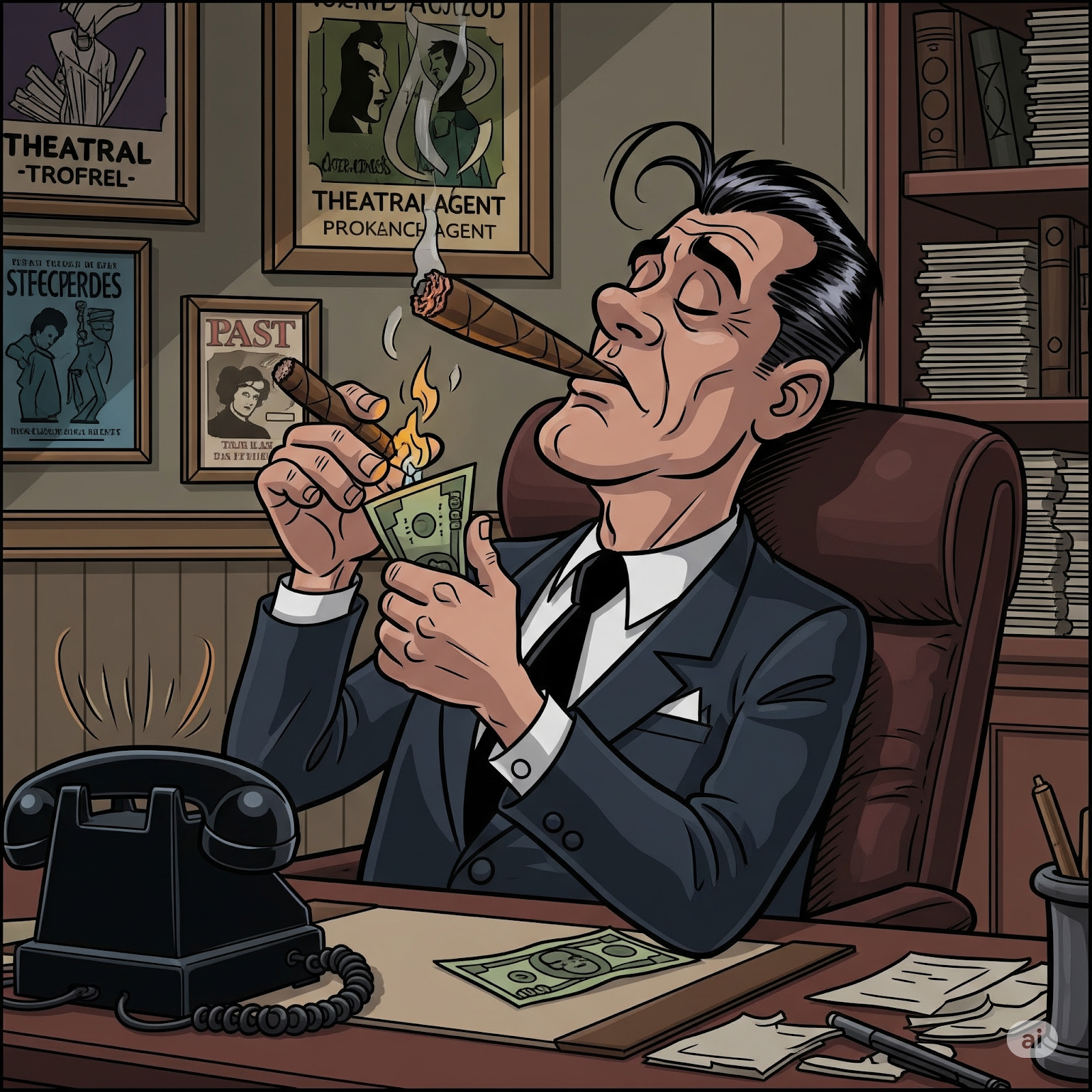


Some agents are in it for the artists, some are in it for the money


When a producer logs into Spotlight, they see a directory.  Folders and subfolders for each of the shows that they’re producing, as well as their previous productions.


Every production folder contains subfolders for each character.  Every subfolder contains the profiles of everyone who’s been submitted for that role.


It’s not possible to audition everyone who is submitted for a role.  Instead, the producer looks through the CVs and watches the showreels.


If you are running multiple shows, or have lots of submissions, it may not possible to look at every CV and/or watch the showreels.  Honestly, it’s not for wont of trying – we get many less submissions than big companies and when we do casting we work 100+ hours weeks.  If numbers are so high that hard work isn’t enough, you have to find ways to whittle down the inbox to something you can manage.


I can only speak for us, but here are some of the tricks we use:


If an agent has submitted more than 5 people for a role, we don’t look at them.  Some agents submit 20+ actors for every role, even though our character breakdowns are very specific.  It simply isn’t possible that they represent so many actors that match the brief.  They haven’t read the brief.  They’re just submitting everyone.  Even if one or two might be good, that means 90-95% of our time looking at their client’s profiles would be wasted.


If we’ve had a bad experience with lots of actors from a particular agency, we don’t look at any of their submissions.  What counts as a bad experience?  Here are a few:

  • Not showing up for your audition slot (without explanation).  
  • Turning down an offer for the role you auditioned for any reason you knew in advance (“it’s too far from home” “It’s at Christmas” “It isn’t TV”)
  • Accepting a role then gazzumping the company for a “bigger offer”
  • Claiming to live withing 25miles of the venue at the audition, then changing your mind after offer and negotiating for subs. 


Of course, things like this are bound to happen – they are to be expected.  As you also might expect: the more shows you produce, the more times things like this will happen.   What you might not expect is: when things like this do inevitably happen, and you go on spotlight to make a note for future reference, how frequently you see the same few agencies pop-up. How many times must you see the same name, Agency XYZ, before it becomes reasonable to assume Agency XYZ has a culture you don’t want to work with?  5?  10?  You can decide your own number.  We have our own – and after an agency reaches it, we don’t look at their submissions.


If we have a few bad experiences with an agent (or possibly just one big one), we don’t consider their submissions.  What are bad experiences we have with agents?

  • They don’t respond to emails
  • They don’t confirm attendance to auditions
  • They are rude on the phone
  • They don’t read the contracts properly
  • They don’t read the brief/they submit performers who aren’t interested
  • They are extremely pushy


If you are reading this thinking: why don’t I ever get called for a Big Tiny panto, there is some non-zero chance that you have been submitted, but we haven’t looked at your profile, simply because of who represents you.


BAD AGENTS: Costs...


Of course, you may have a really bad agent: an agent that’s losing you work.


Every year, when we send out offers to actors, there are a few we end up chasing.  Usually, the agents are dragging their heels on purpose: e.g. waiting for yes/no on some bigger contract (third round Les Mis, some bigger panto), and when pressed for a decision will usually try for a betterment clause.  However, some claim they’ve “not had any time to discuss it” (code for “I’ve not sent it on.”) and some agents just stop replying at all.


I’ll repeat that: some agents do not return emails or answer their phones. 

So…

The role gets offered to somebody else.

 One time following 2 weeks of silence we sent out an email rescinding an offer, only to receive an angry reply explaining they hadn’t been answering answerphone messages or emails because they were waiting for their client to come back from holiday… and now they had, they will accept!  Too late.


Some agents literally stop their clients getting paid

Luckily we’ve not had a repeat of that this year.  Although we did have an email from an actor asking for feedback; our response? We offered the part to you 10 days ago – we’ve tried to chase up your agent twice since then.  Would you like the part?  

 Delightfully they said yes!


ALTERNTATIVES:  Co-ops and Self-rep


What about you? Do you have a great agent, a good agent, a good-enough-for-right-now agents, or a good-grief-I-need-someone-better agent?


Maybe your agent is somewhere in-between. 
They might be great at networking, awful at admin.  
They might be great, but some of the time, until they’re overworked - then they’re awful. 
They might have been great when you signed with them, then they signed 200 others and now you’ve not heard from them since March.

If that sounds like you: remember you don’t NEED an agent.  Alternatives do exist.

You could become part of an actor’s co-operative.  A co-op is a group of performers who band together to share the costs and responsibilities of representation, with members taking turns to submit each other for roles and handle basic admin tasks. Popular co-ops like Act On It and The Actors' Co-operative typically charge a monthly fee (usually £20-40) rather than (and/or in conjunction with*) commission, giving actors more control over their submissions while splitting the workload of monitoring Spotlight and managing applications. 

 *thanks to the proof reader!

You don't have to be able to afford shop in co-op to join a co-op

On one hand, you’ll save on commission, on the other, your committing to giving time. Whether that’s worth it or not will depend – but for someone with lots of time but not lots of money, it’s got to be worth considering.


Or, of course, you could self-represent.  Watch the Spotlight board yourself, read the breakdowns, submit.  Communicate directly with the producers.  Send your own invoices.  You might have to learn a few things – you may not be a natural adminner or an accounts-whizz – but then again, plenty of other actors manage it: they can’t all have A-level business administration!  *SEE APPEND


I can’t speak for everyone, but honestly, The Big Tiny have never not called a performer because they were self-represented.  If you’re already having some doubts about your agent, you could always try giving self-rep a go… there’s little to lose, and you might even discover some talents you never knew you had.

Remember 10x8s?  Those were the days!
 

TLDR:


·      Every actor would love to have a great agent.  

·      There aren’t enough great agents to go round.

·      Having an agent (any agent) has a cost

·      Having a not-very-good agent has hidden costs

·      Bad agents can lose you work

·      You may be better as part of a co-op

·      Self-represention is a viable option


Helen's original comment. 


This is an interesting blog post, but there are quite a few things in it I would query.
1. Co-ops (in my experience) usually have lower commission than traditional agents but not *no* commission. 
2. The 20% commission you state in your remarks about what an agent keeps/takes is not universal. Some agents charge less than this -*especially* for theatre.
3. Most important of all in the discussion about agents: 
Yes, you can self submit on Spotlight without an agent. BUT- an unrepresented actor only sees a TINY percentage of available jobs on Spotlight. An unrepresented actor simply won't *know* about most Spotlight- advertised opportunities if they don't have an agent. 
It is so important for actors to knowhat to look for in an agent.

-----

ADDENDUM


Helen's third point is very apposite.  However, my limited search skills were unable to get any clarity wrt the size of the discrepency.  The following response was returned by Claude 4.0 Sonnet AI.

The commenter is partially correct, but it's more nuanced than they suggest.
Here's what the evidence shows about role visibility on Spotlight:
Self-represented actors DO see fewer roles than agents, but not necessarily just "a fraction." There will be projects that are only sent to agents, and that is the benefit of having an agent – sometimes they'll see slightly different projects to what you see as a self-represented performer. Tips for Using Spotlight When You're a Self-Represented Performer | Spotlight
The key differences are:
Agent-only roles exist: Casting directors have the option to curate which agents they prefer to get submissions from. How Spotlight Really Works Some casting directors choose to send certain breakdowns only to agents, not to all performers.
"All performers" roles: Many roles are sent to both agents and self-represented performers. Casting directors post roles to the Spotlight Jobs Board to all agents and all performers, regardless of agency status which they see in their jobs feed when signed in. FAQs and Help for Performers and Actors | Spotlight Link Jobs Board
Private lists: There is truth in the rumour that "higher tier" agents, for want of a better phrase, see higher profile casting breakdowns. How Spotlight Really Works This suggests a tiered system where established agents may receive access to more premium projects.
However, self-represented actors still have significant access: With the jobs feed board, casting directors can choose to send a project to both the agents and performers, and that means that you'll be seeing that side of things. Tips for Using Spotlight When You're a Self-Represented Performer | Spotlight
The reality is that while self-represented actors may see fewer roles overall, they still have access to a substantial number of opportunities. The exact proportion isn't publicly disclosed by Spotlight, but it's not accurate to say they only see "a fraction" - it would be more accurate to say they see "somewhat fewer" roles than agents do.

Thursday, July 25, 2024

Drag Queen Dames: Good, Bad or Non-Binary?

A bit of a thorny-mind-twister this week. I've followed a train of thought that started off with the question : "should drag queens play dame?" took a detour through websites of acting agencies and nearly derailed itself on the philosophical musings of 18th Century Germans.  

Still, preferable to the transpennine express. 

ToOt ToOt! All aboard!

Non-Binary Performers and the agents that represent them... 

What an AI thinks a gender non-binary casting website would look like.
by Anne AI  


This week we’ve been dealing with an agency (not pictured above) which divides its performers according to gender. Nothing unusual in that of course. A lot of agencies list their clients as male and female: it makes their list easier to search. 

 However...

... this particularly agency divides its performers as follows:

1. Male 
or
2. Female and non-binary 

Which is an unusual -
    -    and thought provoking  -
           - choice.


🙏 Huge apols to all the sticky-beaks out there, I’m not going to name the agency here. Not because I think they’re doing anything wrong, or have anything to hide, but merely because I’m going to delve into some controversial topics and anyway… the ideas are the important things, not the individuals. 

Let's go back and read that categorisation again:

1. Male, 
or
2. Female and non-binary

...
...
...
...
elipsis


I don't know about you, but to me at least it’s a grouping that immediately stands-out. 

       ? Why are the non-binary performers grouped with the female performers? 
              ?  What is it about the "Female and non-binary" performers that makes a cohesive group? 
? Does that mean all these performers are biologically female? 
                               ? Does any of this matter?
                            ? What's going on with the crazy formatting of this paragraph ?

"❓"
 
Question mark indeed!  I don’t know about you, but if I was biologically female and told my agent: “My subjective experience of gender means that I don’t identify as a female, despite my biological sex,” I’d be a bit teed off if they then lumped me in with the females anyway. 

🚩 I MUST FLAG at this point, that I am not non-binary. I feel very binary. I feel very male. In fact, I feel so binary that I struggle to imagine what it means to say “I feel non-binary.” That being said, I’ve met countless people who struggle to imagine what I mean when I say “I feel gay,” (in fact, truth be told, I’ve felt several!) so I am definitely not about to gainsay somebody else’s lived experience based on my lack of imagination. 🚩

However, as peeving as I imagine it would be to be non-binary and lumped in with the females because of my biological sex, I cannot imagine a world in which a performer who was biologically male comes out to their agent as non-binary only for their agent to relist their profile alongside all the women. Of course I could if they were trans… but non-binary? 

My best guess is, the agent has grouped their clients together by casting. If a producer is looking for a woman, they’re looking for someone who can be read as a woman by an audience. 

A Producer's Perspective


From the producer’s POV, does it really matter whether that person feels like a woman, or feels non-binary? After all, the audience won’t know… unless you put it in the programme. (Should we be mentioning it in the programme?  Is that something that people care about now?)

The same logic presumably belies Spotlight’s decision to list “ethnic appearance” rather than “ethnicity.” I mean… if you look like you could be Greek, why not put yourself forward for the part of “Young Greek Man”? 


Ancient Greek Drag Queens were often children.
NO JOKE:  click here for article

The cynics amongst you may well note that “it’s all very well picking Greek as an example… you couldn't very well make the same argument for a dark-skin-tone white actor claiming to be black or mixed race.”

OH, COULDN'T I?!

No, I couldn't. You’re right. A better arguer than me would try to point out that the performative portrayal of Greek nationals isn’t contextualised by the same historical racism as black-face or yellow-face, but honestly, I think if the Equity Balkan committee came out up-in-arms, the industry would quickly capitulate. 

Nevertheless, in a world where the difference between your Aladdin being cancelled or sold-out is whether your publicity shots feature someone perceptibly Chinese or not, producers may find some considerable value in “appearances” rather than “identities.” I can bet you a yuan to a dollar that there have been more than a few marginal casting decisions that came down to which white actor looked most like they could be part Asian. After all, nobody wants to shout “racist” at someone only to find out it’s actually you that assumed someone’s race! 


Artwork for Aladdin 2022.
Can you tell whether the actor on the left actually is Chinese
or merely has a naturally Chinesey face?

But what about all those parts where producers are looking specifically for a non-binary actor? There are an increasing number of them. So much so, that Spotlight issues the following exemplar phrasing to anyone staging an all trans/non-binary cast: 

 ‘We are looking for a cast of actors who present as trans/non-binary. We want to create a piece that is ‘gender euphoric’ and actively utilises the knowledge and lived experience of trans people within the work. If you are comfortable to bring your life experience to the production, whatever trans identity you have, then we’d love to hear from you.’ 

Well, in that case, you’ll hardly be wanting to trawl through an agency website to try and locate their non-binary needle in a haystack of female performers. 

 So...

What’s the alternative? 

You could always plump for:
1. Male 
2. Female 
3. Non-Binary 

                                                                            But IMHO that feels intellectually clunky...

Non-Binary identities reject the received Male/Female sword of Damacles that hangs over the head of society. Surely NB should sit outside the binary, not alongside it!  By which logic, I suggest: 

1. Binary 
2. Non-Binary 

- with the first option forwarding you to a secondary page listing all the non-NB performers as Male/Female accordingly. 


💻If you’re worried your NB performers may miss out on any other opportunities, you could add in a codicil to the male and female pages along the lines of: “We also represent non-binary performers. 
💻You may like to consider one of our following clients…” and hyperlink to their spotlight pins. 
💻If you really wanted, you could post something reciprocal highlighting all of your male and female clients at the bottom of your Non-Binary page, but that may be over-egging the pudding. 
💻Or whatever the non-binary equivalent phrase is… 
...over-gameting? 


💁 


Whilst this is conceptually neater, I’m sure that the practically-minded amongst you are already thinking: “what, so now I’m having to click twice every time… I can’t be arsed with that!” Which I think may well be the line-of-thinking the agency tried to head off when they lumped their NBs and their Fs in together in the first place. 

GOSH – it’s all got so terribly complicated, hasn’t it? And so quickly! “We didn’t have any such thing as non-binary when we were kids and now all of a sudden, barely 50 years later, things have all changed!” Too true. 

It's tough, all this change, isn't it?  Here's a picture of my new puppy to cheer us all up again.

Name: Toby Cousins-Richards
Gender: Dog

So what has all this got to do with the panto? That is, apart from the possible increase of left-clicking-finger-RSI amongst panto producers? 

Well, quite a lot as it happens. 

Binary Gender and Pantomime

Other than Shakespearian pastoral comedy, Great British pantomime is perhaps THE genre of theatre in which the interrogation of binary gender is most integrally linked to the conventions commonly associated with the artform. 

A gender-bending all-female (and non-binary) cast performance of 
The Taming of the Shrew at The Hope Mill, Manchester
OMG... this was AWESOME!  Congrats to all the humans involved!

BIG WHOOP!  Saying “gender-bending is a defining feature of British pantomime” is hardly going to be a surprise to anyone reading this blog. 

From the thigh-high-leather-boot thigh slapping principal boys (whose numbers appear to be thinning each year) to the big-boobied crin-spinning pantomime dames, every good pantomime has someone pretending to have a variety of genitals of which they are, in actuality, intercrurally bereft. 

🐓🐱🏀🍆👄🍑👀🌂✅🔔🍐🍼🐍

Old Mother Hubbard went to the costume cupboard 
    to get herself something to wear 
Old costume mistress, looked down with interest 
    Look! Wee Willie Winkie's down there!

                                                                      - traditional Lancashire nursery rhyme 

                                                                        thanks to The W.W. Winkie Estate © no rights reserved


As important as F2M gender swapped casting is to the pantomime, allow me, if you would, to restrict my focus in this blogpost exclusively to the role of the Dame. Ta.

💋

Pictured below is the comment thread under my last blog post in which two posters are arguing whether the dame should be played by a drag queen or not.   It was indeed this debate which kicked me off onto this series of fascinating tangents. 


Are you squinting as hard as I am to read this?

⚠ CAUTION: In case my PhD supervisor is reading, I've had to phrase the following thought so precisely, the meaning of it has been rendered practically unintelligible.  

Any successful parsing of a performative act in which a male performer depicts any female character, must necessarily be predicated upon the acknowledgement that binary gender is the ubiquitous, culturally-dominant paradigm through which semiotics are likely to be contextualised in society at large, and by inference the plurality of audience members. 
 
Paradigm  Pah-Rad-I'm (noun.) Defn. A way of looking at the world.   
For example: "In order to sound cleverer than he was, the academic used the word 'paradigm' when he could have just written 'a way of looking at the world.'" 

Now, just in case he doesn't read this, let me say it again, only sloppily and in ambiguous language.

Men playing women on stage is funny because most people understand gender to be male or female. 

BINARY GENDER PARADIGM = THINKING THAT GENDER IS JUST MALE/FEMALE

In a world in which male and female didn't exist, the dame would be simply a human portraying another human… 


... which is fine!

I’m sure a hilarious human would have great success when performing a well-scripted role of this type. 

However, be honest, that’s not what you think of when you think of dame, is it?

The joke is 
it’s a man in a dress. 

At least, lots of the jokes work because it’s a man in a dress; and by corollary, most of the jokes we enjoy would fall flat were it not so to be. 

 e.g. 1 Picking a boyfriend 
This bit is funny if you’re a man in a dress picking a heterosexual man who you then make feel uncomfortable by flirting with him (particularly if it’s in front of his wife). 

 e.g. 2 Funny innuendoes.  
You know, the ones that the grannies all laugh at, that go straight over an 8 year old’s head… “I’ve got something other women haven’t got” and the like. 

These conventions work because we live in a world in which the shared paradigm through which the majority of people conceptualise gender is a male/female binary. 

If a pantomime dame was played by your-dad-in-a-dress then the funniest person to watch the reactions of would definitely be your mum. 

Of course, you could strip out the gags that rely on this binary, and still have a dame that keeps the crowds roaring… as any one of the great (and most notably Scottish) female dames can prove. 

Scottish legend and veteran panto dame, Elaine C Smith,
delighting a school audience with 10 minutes of improvised tableaux vivantes

BUT if you are stuck on the your-dad-in-a-dress archetype, then ignoring the culturally-ubiquitous gender-binary paradigm just to appear woke would mean cutting out so many crowd-pleasing classics, you might as well audition for King and let someone else have the funnies. 

Notice my careful description of dame as your-dad-in-a-dress… not, as the more well trod description has it: dame as a-man-in-a-dress

A man-in-a-dress describes all kinds of people: pantomime dames, drag queens, Grayson Perry, catholic priests or anyone out on a stag night north of the M62. 

Boris Johnson as Dame Hard Brexit, battling on through the ghost gag
after a slow puncture left both of his blow-up boobs deflated.
 
However, not all of these men are your-dad-in-a-dress. (NB I can’t actually prove that, but if I know one thing about your dad’s agent, she’d never agree to him doing that number of costume changes!) 

Out of these groups, only drag queens see significant cross-over with the part of the pantomime dame.  A cross-over which (as is evidenced by the FB debate shown above) is NOT UNIVERSALLY supported! 

If you love reading somewhat conceptually garbled articles that try to claim that panto dame is in fact drag, try this one from the Grauniad.

In fairness to the Grain, the similarities between drag and dame are easy to see.   I bet you could easily name a dozen: 

They’re both men in dresses (1), often FABULOUS dresses (2), extraordinary wigs (3) have great big fake boobs (4) and a ton of make-up (5). Both characters are performed on stage (6), both interact with the audience (7), crack jokes (8), innuendos (9) and improvise (10) as well as regurgitating classic one-liners (11). And many of the best ones have a secret hipflask waiting in the wings (12). 

Given the overlap, you may well be wondering: what stops a drag queen from being your-dad-in-a-dress? Answer – your mum! And that answer is not quite as frivolous as it may first appear to be.


I know, I know. STOP BITING MY HEAD OFF!
                         YES: There are straight men who do drag. 
        and some women,
                     and some bisexual men,
                            and also non-binary humans, and… 

Before you list off the rest of the LGBTQA2SNB+ alphabet at me, you have to concede, in the broadest of brushstrokes, that the drag queen is an AOGMO (archetype of gay male origin). 

The conventions of drag queen performance are borne of, and therefore contextualised by a history of gay men performing to queer audiences, in queer run venues, in spite of and in juxtaposition to the pervasive heteronormativite norms of the broader culture at large. 

The performance of drag is a political act that challenges the heteronormative binary of “normal vs queer” – or as the gays amongst us grew up feeling: “them vs us”. 

 The power of the drag queen comes from the shared identity of the LGBT+ community. When we transplant the drag queen into the heteronormative family-centred performative context of pantomime, we alienate the archetype from the power it usually wields. 

The drag queen dame finds herself in the exact same position as the dame that's your-dad-in-a-dress.  Denuded of any external context, both types of performer must now make their hay from the shared male/female binary paradigm of the family audience… the very same heteronormative binary drag once evolved to reject. 

Performing a drag-queen-as-dame demands that the members of the audience reframe the act of the male usurpation of femininity as a mask, no longer in terms of lampoon or bouffon, but as a declarative affirmation of the performer's queer identity.   

OK, society has moved on a lot, but the truth of the matter is most people who have kids to take to a panto are straight. (Trust me, my husband and I have been trying to have kids for years. Still nothing. I’ve had my legs up against the wall and everything!) 

 Can a straight audience enjoy drag? Of course!  But when they do, something fundamentally different is happening than when the same audience watches a dame who is a-dad-in-a-dress. They watch. They spectate. They do not commune. 

Not in the same way the ragtag crew of a gay bar commune with the drag queen on Friday nights. Nor in the same way their granny and grampa communed with the cock-in-a-frock playing Twanky back in the 70s. 

 How could they? 

How can a straight family understand all of the history, community, connotations that come with the drag queen?  

They can laugh.  But they can’t understand

You may counterpose: "drag has evolved far beyond its queer meaning."  You may point to Drag Race and mega star celebrity drag queens like Lily Savage. 

And yes – it is true. 

Just as our society has grown to accept and include queer people, queer performance and archetypes have both become much more accepted and represented in the public sphere. And all of this is to be much applauded. 

Thanks for all the laughs, Paul.  We'll always love you x 


The same hard work and bravery of queer activists that gifted acceptance and visibility to the LGBT community also gave straight society drag. When drag queens do panto they’re helping to edify that connection. They’re flying the flag for queer culture and for anyone who feels marginalised or excluded. WHAT MARVELLOUS WORK! Our drag queen dames should be supported and celebrated for all this and more. 

It is utterly commendable

But it’s different to what’s going on when you’re watching your-dad-in-a-dress. When a drag queen tells a bloke in the front row “you’re gorgeous,” the line is contextualised within a gay paradigm. When your-dad-in-a-dress says the same line, it’s contextualised within a binary-gender paradigm. 


And if all of that doesn’t scream Hegel to you… you must have slept through your BA epistemology tutorials!  Shame on you!

Equity representative promoting rural, touring and regional pantomimes


If you can bear to stay with me for just four more teensy-tiny, incredibly dense paragraph that reframe the debate using Hegelian Dialectics, then I promise I’ll make it all worth your while.

If you can’t be arsed, you can skip this bit and then just pretend you read it should we later bump into each other at an award ceremony. 

If you're skipping, skip now!

In layman’s terms, and assuredly making a hash of it all, what Hegel argued was: for any idea (or thesis), it can only be understood in the context of it’s own negation (antithesis). True understanding means bringing these two thoughts together to reveal a greater truth (synthesis). Hegel was talking about logical arguments, but the same pattern continues when we think about identities. This is because identities are necessarily defined by juxtaposition to a defined out-group. 

To understand what it means to perform drag, we must understand what it means to be gay. Gay identity can only be understood in the context of a heteronormative societal mores, with the synthsesis of these counterposing identities informing a queer paradigm. Thus, when a dame is performed as a drag queen, the audience’s reading of the character is contextualised within a paradigm of queerness. 

However, when a dame is performed as your-dad-in-a-dress, the audiences are prompted to understand the character through the lens of the performer's maleness in juxtaposition to the femaleness of the character.  It is the synthesis of these counterposing male/female identities that informs our understanding of binary gender.  

NB Non-binary identities iterate this abstraction. To understand what it means to be non-binary, we must first understand what it means for gender to be paradigmatically binary, and then synthesise these counterposing identities to understand gender as a continuum. An interesting thought exercise for the academic is to ponder how this process might further be iterated, and in so doing to second-guess what type of novel identity may well be synthesised by the generation that follows. 

Despite attending 4 weeks of puppy socialisation
Toby still doesn't have even a basic grasp of Hegelian Dialectics

 IF YOU SKIPPED, PICK BACK UP HERE! 

So where do I fall on this debate? 

Well, I like watching drag, because...

I also love watching a man perform dame like my-dad-in-a-dress. I loved my dad... and my mum... with their weird heteronormative marriage, that they both conceptualised through their own little male/female gender binary paradigm. It is a paradigm that we all intuitively understand, even those who may no longer live within in it. 

Would I laugh if my dad put balloons up his jumper, wore lipstick and said in a high, girly voice “ooh, me knickers are right up me bumcheeks!”

❓ 

You bet I would! I’d laugh like a hyena. And so would you. And so would your mum. And so would your agent's mum. And so would your agents female/non-binary client’s mum. 

And there’s nothing wrong with acknowledging that it’s funny because, for the majority of our society at large, the gender binary that makes it funny actually exists. 

Even if we reject it ourselves. 

 ;TLDR 


1. Traditional panto requires gender binaries 

2. It is OK to acknowledge that for large swathes of society, the traditional gender binary is the dominant extant paradigm (even if we reject it ourselves) 

3. There are important differences between how a drag queen is read compared to traditional dad-in-a-dress dames.  

4. My preference is to script, cast and direct the dame like my-dad-in-a-dress, and to get my drag fix when I go to the gay bar.  Other preferences are available.

5. Every dame performer, regardless of style, deserves our support and celebration.

Did I mention I've got a new puppy?


Can you call someone the N word if you have Tourettes?

Hello my lovelies! Just when you thought it was safe to get back in the water, I’m back with another panto blog. My apologies for keeping yo...