Showing posts with label playwright. Show all posts

Friday, May 5, 2023

Panto isn't for kids, you 'nana!

The Biggest Lie in Pantomime

If there's one prevalent myth that needs busting, it's that pantomimes are for kids.

They aren't.

At least, our pantos aren't.  

Of course, there are producers who make pantos for kids.  That's why their pantos are crap. 

Ours are much better than that... our pantomimes are family entertainment.

This is a point I often have to iterate when I come across panto-refuseniks and try to persuade them to come along.

"I don't have any kids to bring with me," they say - as though that's a reasonable excuse not to snap up a ticket.

"You don't need to bring any kids," I explain.  "Family entertainment just means it's suitable for families.  It's really great fun for grown ups too."

This message seems to have permeated our local audience (in Saddleworth, 70% of our tickets for public performances are sold to groups without children).

Of course, we make the shows with kids in mind.  It's kinda pantomime's schtick.  But the honest truth is: children are not a particularly discerning audience.


Kids Being Easily Entertained

Photo by Dionehinchliff, CC by SA-2.0


I'm not saying kids don't know what they like - they obviously do.  Kids like bold characters, funny jokes, bright colours, slapstick, gunge - a good pantomime uses all of these elements.  However (and I'm sorry if this comes as a surprise to you) there are a lot of downright awful pantomimes out there, and most of them have all these elements too.

That's not to say that kids will like any old tosh.  It is certainly possible to make a show that kids don't like - I've seen a fair few pantos that fall into that category (OMG, you are really in trouble if you make a panto and even the kids don't like it!)

But the problem with making shows 'for kids' is that it demands you meet only the lowest of standards.  

Who cares that the Uglies were wearing old rags, did you hear all the kids shouting 'boo' when they tore up the invite?  

Who cares that the plot didn't make any sense, did you hear all the kids sing along to Baby Shark? 

Who cares that Wishee-Washee has no discernible character arc, did you hear how loud the kids shouted "Watcha Wishee!" when he came on?

Kids don't care.


Who cares?

Photo by radarsmum67; CC by 2.0

Does anyone care?

Adults care.  At least they should.  Up and down the country, adults attend truly terrible pantos for all kinds of spurious reasons ranging from guilt to tradition. 

By contrast: good pantos are enjoyed by everyone: kids and adults alike.

Not only is it good art, it's good business.

Remember, adults buy tickets, children do not.  The big panto in town might be 'good for kids', but if mum and dad love the panto down the road, then down the road is where they'll be heading.

Also - not every family has young children.  If your business model relies on pester-power to get bums on seats, you've excluded a large potential customer base.  Furthermore, even families who have young kids, don't have young kids forever - kids grow up, and once they do, shows 'made for kids' lose all of their pulling power.

Demographic shift is coming.  Families are getting smaller; audiences are getting older - and these trends are only becoming more pronounced.  Even if pantomime's were supposed to be shows for kids (which they aren't, but hey ho...) the relative customer base is declining, which is why the smart money's on companies who can diversify what they're offering to meet the evolving requirements of the market share they've established.


The UK's Aging Population


How to tell if your panto is crap

So you've put on a panto.  You've sold a few tickets, some programmes, the odd flashing sword and a fairy's wand or two.  You saunter round the bar at the interval... everybody seems happy enough.  But then again, you remember, it's Christmas - people are always happy at Christmas.  Maybe they're just glad they're off work tomorrow.   Doubts creep in.  

You decide to get some quick audience feedback.  You smile and approach a young mum.  "Are you having a nice time?" you ask.

She smiles and replies - maybe not quite as effusively as you would have liked.  Of course, you were probably hoping for something quite clear and direct, such as: "OMG, WOW!" or perhaps "Watching Act 1 of this play has been a key, seminal moment in my life."  So now you're left trying to pick through her words to parse what she really feels.

Here's a handy quick guide to help you translate:

WHAT THEY SAY: "It's really great.'

WHAT THEY MEAN: "Well done. You've made a good panto."


WHAT THEY SAY: “The kids are loving it. 

WHAT THEY MEAN: “The panto is crap, but the kids are too young to realise.” 


WHAT THEY SAY: “My eldest's a bit old for panto. 

WHAT THEY MEAN: “A 12 year old can see that the panto is crap.” 


WHAT THEY SAY: “I just like watching the kids enjoying themselves” 

WHAT THEY MEAN: “The panto is so crap, I would literally rather watch other members of the audience than the performance’."


WHAT THEY SAY: “There were loads of kids in the audience” 

WHAT THEY MEAN: “The panto is so crap, local people now take it in turns to chaperone each other’s kids so they can have a year off.” 


WHAT THEY SAY: “My favourite bit was where you got the kids up on stage."

WHAT THEY MEAN: ”The pantowas crap, but you saved it with a good song sheet."


Doing something better

The first step towards recovery is admitting you have a problem.  

Don't panic.  You're not alone!  Trust me, I see dozens of pantos every year - loads of pantos are crap.  The good news is, they don't have to be.  Despite what you may been led to believe, it is not beyond the wit of man to write a show that simultaneously contains enough slapstick, gunge and puns to entertain a child, whilst also including enough character comedy, tension and jeopardy to entertain an adult.

How?

That's a trade secret, one that I share only with the few select people who actually read my blog... 

... get ready...

... here it comes... 

... the trick is...

...

... instead of regurgitating any old nonsense, write something genuinely entertaining.  And by that I mean: entertaining for an actual, discerning grown-up.  

I know what I'm about to say might seem totally crazy, but trust me, it totally works.  If you write something so funny it makes grown-ups laugh, kids will laugh at it too!  I know right?  Who knew!  

And it's not just for jokes either - if you write something that's genuinely moving - in the sense that it engenders pathos in an actual, discerning adult, the very same scene will move the kids too!  

Ditto for tension.  

Ditto for catharsis.  

Ditto for dramatic irony.  

IN FACT, it turns out that to make a good kids show, all that you really need to do is make a good show and then let the kids watch it!  

So now you know.  Remember: mum's the word!  It's a trade secret.  Don't spread it around, or everyone will start making good pantos, and we wouldn't want any of that!


Mum's the Word
Photo by Simon_music; CC by 2.0


Saturday, March 25, 2023

"What shall we do with him, boys and girls?" Reclaiming the Villain


The slap heard across Liverpool


Last week I went on a school trip!  An Inspector Calls at the Liverpool Empire (the one directed by Steven Daldry where the house… well, something happens to the house - I won’t spoil it for you if you haven’t seen it. (Also, you should really have seen it at least once by now, it’s been 30 years!)


Marquee for An Inspector Calls
Photograph by Colin Smith © licensed under Creative Commons

An Inspector Calls is a GCSE set text, which means: a) even though its a 1940s drawing room drama, you can sell out the Liverpool Empire, and b) your average audience age is about 15.


If you don’t know the play, there is a part where Miss Burling, newly engaged, finds out her fiancé has been keeping a mistress (SPOILER ALERT - But you really should have read it by now, it’s been out for 78 years!).  An argument ensues, topped off with the most almighty crack as she slaps him across the face.  It is a Real-Housewives-cum-Kardashians moment anachronistically thrust into a 1940s stage play.  The young audience, apparently more used to watching bar-brawls than theatre, approved very much of the love-rat's comeuppance: whooping, clapping and whistling - if JB Priestly ever wished he would write a Jerry Springer moment, his wish has been granted.


I must confess, the children I was sitting with from Rydal Penrhos were impeccably behaved.  The two in front of me even joined in with the customary roil of teachers' shushing, and it wasn’t long before the youthful crowd’s enthusiastic outburst was tempered.


Audience expectations


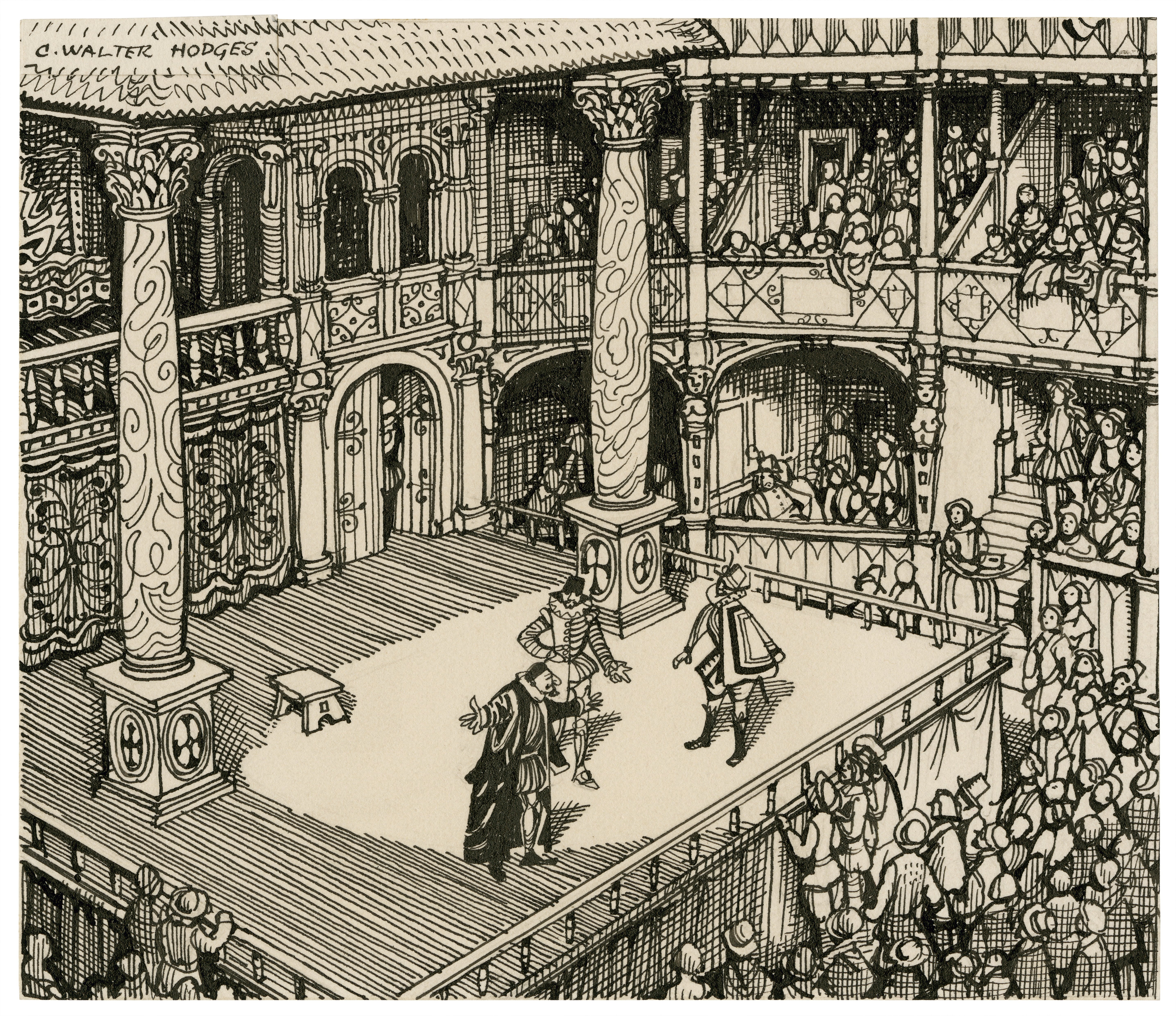
When it comes to putting up with teenagers at the theatre, 15 years as a secondary school teacher have given me a thicker skin than most.  It is easy to forget, that the before the great and the good inculcated our contemporary culture of respectful silence and earnest consideration of character development, the theatre used to be a palace of raucous delight, where audience members were as likely to shower the actors with food as applause.

Illustration of Elizabethan Theatre,
w. thanks to C. Walter Hodges, CC BY 4.0 via Wikimedia Commons


It is a learning point oft remembered that Elizabethan and Jacobean theatres were built in a similar style to bear baiting pits.  Blood sports were incredibly popular in our glorious iambic past.  Audiences were just as likely to buy a ticket for a cock fight or a bear knuckle boxing match as they were to attend a theatrical performance.  To an OG Shakespeare season ticket holder, the jeering, drinking, and jostling through the throng were just as much part of a great play as they were a good bull fight.  Theatre in the round puts the actors in a vulnerable position: they are enveloped by the audience; they don't just perform for us, we commune with them.  Indeed, shortly after Ben Johnson debuted Bartholemew Fair at the Hope Theatre, the venue changed its name back to the Bear Garden.


In the wonderful page-turner The Pantomime life of Joey Grimaldi by Andrew McConnell Stott we are treated to eye witness accounts of some of the earliest shows that we would recognise today as panto.  Producers plying their customers with cheap booze, audience members jumping  over the circle balcony and up onto the stage, followed inevitably by police interventions.  Theatre was vital, visceral, communal.


Poster advertising panto pioneer Joey Grimaldi


We don't even have to go back as far as Joey Grimaldi to find traces of a more vivacious theatre culture.  For only sixpence for a stalls ticket, audiences packed out music hall and variety shows even within living memory - a form of entertainment with "a reputation amongst the middle classes for their vulgarity and distasteful performances."  Doesn't it sound delightful?


Pantomime is the honest descendent of these traditional performance cultures.  Of course the audience want to shout out and warn the hero "it's behind you!", obviously we want to boo and hiss the evil Abanazar, naturally the school kids go wild when the heroine slaps her philandering fiancé.  It is the expecectation of wallowing, detached in moribund silence that is peculiar.


The REAL Housewives of JB Pristley


Back to An Inspector Calls for a moment.  As the play unfolds, there are further stage combat sequences.  The young Burling boy manhandles his father and smashes a whiskey bottle, but special effect break-away glass notwithstanding, the children were less impressed.  By that point, the character in question has already been unmasked as a rapist, and though he has a good go at repenting, it’s hard to root for him completely.   The various revelations garnered fugues of “ooh”s and “aah”s, but nothing topped the response to the slap… It turns out, lamping a love-rat is a veritable crowd pleaser.


The cheater is wicked. He deserves to be punished. At its heart, pantomime is built around Manichean narrative structure. Fairy Bow Bells is good, Queen Rat is evil. We want Jack to save the day, we are delighted when Fleshcreep is crushed by the toppling beanstalk.


And why not?


Doing something better


Unfortunately (to my mind) there exists in certain circles a propensity to water-down and bowdlerise the narrative on the pretence of upholding contemporary mores: 'We shouldn't glorify violence', 'we should be teaching our kids to forgive and make-up'. Nonsense!  


How many times must we endure Fairy Feeble telling us: "I know, if I wave my magic wand Carabosse will become good again?" What a yawnfest! Drama requires climax; catharsis. Not mealy mouthed moralising from magical misfits. When we put on a panto we proffer a promise: trust us, come with us and we'll take you on a fantastical journey through trials and tribulations, love, laughter, jeopardy and hi-jinx. At our behest the children harry the evil doer, they sit on the edge of their seats when Red Riding Hood is chased by the wolf, their hearts are torn in two when Cinderella rips up her invitation to the ball. For what? So in the last 5 minutes we can say "Oh well, it didn't matter anyway. There are no consequences. Pick up a programme on your way out!" What's the lesson the kids are supposed to take away from that? They should try harder at magic? We might as well just project the words "And then they all realised it was only a dream" and be done with it.


We all know what our audiences want. When Robin Hood finally bests The Sheriff in act 2 scene 6, he raises his sword high in the air and cries out "what shall I do with him, boys and girls?" And what do they shout back: "Kill him!" Like clockwork, every time.


The wonderfully wicked Sheriff played by Big Tiny legend, Larry Stubbings
Robin Hood, Huddersfield (2021) ⓒ The Big Tiny


The spuriously qualified yet somehow still-vaunted father of fairy stories, Bruno Bettelheim (don't get me started - my rebuttal will need it's own blog post) argues that

"the appreciation of mercy… baffles the child.”   
- Bettelheim, B. The Uses of Enchantment (1976) p144

It stands to reason.  In his review of Maeterlinck's The Blue Bird, the late, great GK Chesterton tells us why:

"for children are innocent and love justice, while most of us are wicked and prefer mercy."

 - Chesterton, GK.  On Household Gods and Goblins (1922)

The wickeder the villain, the more delicious is his downfall.  Last year I incorporated a daring and novel twist into my script of Aladdin.   From the very first line of the prologue, Abanazar is promised by destiny that he shall rule the world in the end.  His fate is never in doubt (of course not... he has an omnipotent genie - duh!).  In the final scene, when the Twankeys, the Empress, policemen and Jasmine are all cowering before him, he unabashadly relishes his triumph:

Abanazar: ... continues

And that’s the real moral, kiddos - nothing matters, only power
The strong will take their fill, the weak must step aside and cower
Teamwork doesn’t makes the dreamwork,
True love never finds a way
Good things come to those who seize them
Cheaters win and crime does pay

Hahahaha.  Hahahaha.

“But the goodies always win in the end.  It’s a pantomime.”
Newsflash: This is the end.  The last page, the last speech, the last seconds.  I’m afraid you’re all out of time.

Thank you for coming and cheering your side
If you want to know what happened next, they all died.
You did your best booing, but my victory was built in
Try a bit harder next year’s Rumplestiltskin.

I wish you all the most unhappy Christmases, and a horrible New year’s day
Bog of home you bunch of losers.  And that’s the last line of the play.

 - Aladdin by Ben Richards © 2022, The Big Tiny

And true to his destiny, as the last line of the play is spoken, Abanazar clicks his fingers and... BLACKOUT.

You could hear a pin drop.  Every night, it landed.

Here they sat, hundreds of children and adults alike, so invested, so horrified, so caught up in the tale we wove, that they gasped as one body.

I shan't tell you exactly how Aladdin managed to get himself out of that: but enquiring minds can read the review here.

The point is, IT MATTERED.   

Did we forgive him?  Not on your nellie!  Did he magically turn good in the end?  Does any villain?

The fairy tales upon which pantomime is based started off as cautionary tales.  Don't accept sweets from the wicked witch, steer clear from the big bad wolf,  if there's a bear living somewhere don't let yourself in.  Where are the cautionary tales for modern day threats?  I've never been chased by a wolf, but I've met a few conniving narcissists who believe it's their destiny to rule the world. 

So what did Aladdin (and everyone else) learn in the end?  Simples - not everyone should be trusted, kiddos.  Some people are only in it for themselves, so keep your wits about you!

Or, as Abanazar himself summed up during the dum-de-dums:

"Beware those who use their power to coerce,
They make themselves feel better by making others feel worse"

- Ibid


Give the people what they want!  Let them enjoy Miss Burling's revenge!  To all that would hear it, this is my rallying cry "Bring back the villain.  Make panto better."


P.S. I can't wait for you to see what I've been doing with Rumpelstilskin.


The supremely talented David Herzog as a triumphant Abanazar, Market Drayton (2022)  
Photo by Howard Barlow © The Big Tiny


Saturday, March 11, 2023

Has Panto Lost the Plot?

The Ineffable Wisdom of Nigel Ellacott

Two weeks ago I attended the first pantomime symposium hosted by UKPA and Staffordshire University. The day was split into three panels, and during the second panel, entitled: In the Spotlight - Performers’ Perspectives, panto favourite Nigel Ellacott (who last year was awarded the UKPA lifetime achievement award) was invited to reflect on what he felt had changed during his long and lauded career. His reflections prompted a lot of back and forth amongst the panel about feisty princesses and principal boys, and amongst all the constructive debate, he made one more reflection: “I’m sure panto used to have more of a plot.” 

NB the quote marks are merely aesthetic. I’m almost certainly paraphrasing, but I hope you’ll forgive me… the official transcript is yet to be published, and I’m working from handwritten notes. Amid the throng of lively debate, it was a blink and you’ll miss it moment. But it was a comment that resonated so strongly with my own experience that I heard it as loudly as if he were striking a gong. 

To my mind, this singular observation, encapsulates panto’s biggest problem. Moreso than any of the more topical issues that generate headlines and animate practitioners. This is the gigantic elephant in the room: panto has lost the plot. 

If it is to stand any chance of redemption, we must first understand two things: how did this happen and why? 

Damning Evidence 

If there’s one thing panto-people are good at, it’s singing their industry’s praises. You can barely skulk round a theatre in December without hearing someone Trot (sic) off a verse of “Panto is a great British Christmas tradition. It pays for the rest of the theatre’s annual programme” followed by a few rousing choruses of “Hallelujah! Panto is a child’s first experience of theatre.” 

A traditional, first experience of live theatre

 Some of the most evangelical proselytisers may end up as unwitting victims of their own boosterism. I have often been told that pantomime is the most popular form of theatre in Britain. (For the record: it’s not. It’s fifth. Comedies, musicals and kids shows all draw bigger crowds, and top-of-the-list Drama attracts more than twice as many audience members annually.) 

Every year, somewhere between 11-13% of the UK population watch at least one panto. Across the country, that adds up to millions, but the corollary of this is the fact that the vast, vast majority of people who live in the UK don’t watch a panto and have no plans to start any time soon. 

I talk to lots of people about panto, including lots of people outside the rarefied circles of pantomime-devotees. From members of the general population, of course I hear a range of responses, but the response I hear most frequently is “I don’t like panto.” 

You can try to explain how your shows are different until you go blue in the face but, most times, remonstrations fall on deaf ears. Panto-refuseniks are often as dogged in their recalcitrance as fanatics are with their praise. Most punters don’t need to get their fingers burnt too many times before they shy away from the fire. 

It’s hard not to sympathise. There are a lot terrible pantos out there, I’ve watched them. Chances are, if you watch enough pantos, you too will start to question whether you really like them or not. 

So what’s going wrong and how has it happened? 

The first thing to realise is that the label “panto” is attributed fairly liberally to a fairly wide range of show styles. You’d have a very different audience experience watching the Rock and Roll panto in Mold than you would watching the circus panto at the Blackpool Tower. 

Variety acts, celebrity names, production values, actor-musicians, comedy, plot, audience participation - opinions on what makes a good panto good are as diverse as the genre itself. There’s no accounting for taste. 

But once again, it bears repeating, only: 11-13% of people are satisfied enough with the current offer to come back year on year. These people aren’t the reason panto isn’t more popular, they’re the reason it isn’t already dead. More than half of the UK theatre-going population won’t go and see a pantomime. There are millions of people buying tickets for plays who love musical theatre, who do not like pantomime.  If we are to make panto better, we must understand why and improve our offer. 

The Difference between Pantos and Plays 

Ask the man on the street what a pantomime is, he’ll probably describe it as some form of play. Indeed, from the perspective of an audience member, going to their local theatre to watch a play feels very similar to watching the pantomime. You use the same website to buy your ticket, you sit in the same auditorium, buy the same ice-cream, watch actors perform on the very same stage. Yet, the similarity of consumer experience belies crucial fundamental differences between the two. 

Besides pantomime and musical theatre, very few “straight plays” command enough of an audience to make their production commercially viable. The continued success of the UK theatre industry is predicated on the vast central subsidy, primarily through Arts Council England (ACE). ACE funds theatres, artists, and artistic projects to the tune of tens of millions of pounds a year.  These funds pay the wages of full time and freelance staff, without whom, most theatres would not be able to function. This is evidenced by the recent reallocation of ACE funding that precipitated the failure of the Oldham Coliseum.

The recently defunct Oldham Coliseum
Photo by Dancewear Central

 New plays are made when producing theatres commission playwrights. Playwrights typically work as freelance artists, building a reputation based on the quality of their portfolio of work and reviews from their previous shows. It is common for professional playwrights to have some form of professional training. This might be from an HE establishment (e.g. RADA), a professional course (e.g. Royal Court Young Writer’s Scheme) or through work placement at a partner organisation. But even highly skilled playwrights with excellent portfolios may struggle to work continuously. Competition for commissions is high. 

Once commissioned to write a play, the playwright will communicate with and be informed by a representative of the theatre (usually a director or dramaturg). These interactions might be fairly light touch (e.g bouncing ideas back and forth over email); or more formal and collaborative (table reads, feedback, rewrites etc). 

Every day, up and down the country, playwrights and theatres are engaging in processes with the end goal of realising a written script as live entertainment. 

However, this is only sometimes true when it comes to pantomimes. 

Pantomimes are commercial theatre. In many cases, individuals who put on pantomimes do so at their own expense in the hope of making a profit. In the pursuit of profit, producers may seek to economise, and one way of doing this is to cut out the playwright and save yourself paying for performance rights. 

How can you make a panto if you cut out the playwright? 

There are several ways: you can write it yourself, or you can mush together bits of scripts you already have, you can get the actors to devise something, or any combination of these. It’s not uncommon for day 1 of a panto rehearsal to include the director going through what’s turned up from the hire company and working out what they want to do with it. Nor is it uncommon for the SM to spend the two weeks of rehearsal furiously making props in the wings for “bits” that the actors have thought up during rehearsal. 

Can you gather a company of actors and devise a great show? Of course! (Kneehigh, anyone?!) Do there exist theatre producers who can also write a great show? History is littered with examples (William Something-spear comes to mind). Is that what is happening in most pantomimes? Maybe 11-13% of them? 


10 COMMON PANTO CRIMES AGAINST GOOD WRITING 

• The ugly sisters choose a boyfriend and never reference them again.
• Characters turn up in new locations for no discernible reason.
• Cut and paste last year’s stock characters, just change the name.
• Songs with irrelevant lyrics, sung for no reason.
• Divorcing the comic trio entirely from the plot.
• Get kids to shout out if anyone goes near the present. Present is never opened and is removed in the interval set change.
• Writing in "funny jokes", instead of funny scenes.
• Start off by putting in 12 days of Christmas, ghost gag, Two Ronnies, Chocolate bars in a shopping cart, Slosh scene, kiss on the wall sketch, fall over pull down the curtain bit, variety act. Squeeze the plot into 10 one minute scene changes infront of the show cloth.
• Villains are evil for no reason. Then they magically become good.
• Completely omit any sense of jeopardy. No action has any purpose. Nobody faces any consequences. 

At the very minimum can we all make a pact to eradicate these 10 panto crimes? 


Doing Something Better 

So, you’re going to make better panto, what should you do? 

If you’re a venue: hire a playwright. 

If you’re writing a panto, invest in your skills. If you’re new to writing, get some professional training. Join a writer’s group. Read some books about dramaturgy. I don’t think anybody should write a play without first reading David Ball’s extraordinarily pithy dramaturgical how-to guide, Backwards and Forwards: A technical manual for Reading Plays. Also, I’d like to make a big shout out to Paul Sirret for his excellent book The Playwright’s Manifesto published last year. 

I work on panto scripts the same as I do on “serious plays”. There are as many ways to approach writing as there are playwrights, but here are the four steps I take on my way to getting words on paper.

 1. World Building. 

Where are we? How does the world work? What are the prevailing forces that govern the way that the story unfolds? 

e.g. Our Sleeping Beauty (2019) takes place in a palace where royalty are surrounded by wealth. It’s natural to interrogate how this affects the people that live there. Are they callous and jaded? Pompous and out of touch? Profligate? Avaricious? Spoiled? The flip side of money being no object: everything is affordable, but nothing is valued. 

Unimaginable wealth and the people it breeds
Sleeping Beauty, Market Drayton 2019. The Big Tiny (photo by Howard Barlow)


2. Develop the characters. 

Who does the world affect most? Or in a peculiar way? What makes them tick? How do they relate to each other? What challenges could they face? How will their actions affect their circumstance and vise versa? 

e.g. In our recent Aladdin (2022) the action is centred around the Twankey’s squalid favela. The city is constrained by vast inpenetrable walls, fencing the characters in, and keeping the real world out. I developed characters that I could use to explore this world and interrogate the different ways people are shaped by their geography. Jasmine wants to escape from her family, Aladdin wishes to go back home. Widow Twankey refuses to leave her shanty, the genie has a round the world plane ticket but is bound to the lamp. Wishee-Washee collects holiday brochures he can’t read and fantasises about going on holiday while jet setting Abanazar traverses the world by plane, by boat, by camel and doesn’t think anything of it. 
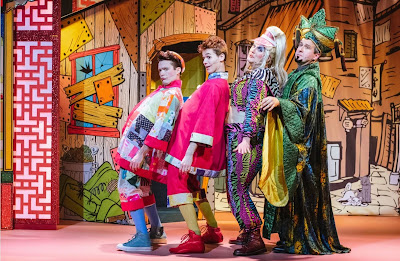
Characters stories are shaped by their circumstances
Aladdin, Saddleworth 2022. The Big Tiny (Photo by Howard Barlow)


3. Structure the plot. 

Give every character an arc: a problem to deal with, a test they must face, an opportunity to grow and develop. Know where all the pivotal moments will come, and put them in an order that leads the audience on an emotional journey. 

e.g. In Robin Hood (2021) I wrote an arc for Will Scarlett in which he fixes a talent show to win a box of chocolates. In Act 1, we see Will practise, putting up posters, preparing his costume, as well as jealously guarding the chocolates from the peckish merry men. All this means that by the time we get to the contest in Act 2, the audience are fully invested in Will’s success, sharing his elation as he reads out first place, and his devastation when the sheriff steals the chocolates. 

Will Scarlett's very clear narrative arc
Robin Hood, Huddersfield 2021. The Big Tiny


4. (ONLY NOW!) – Write in the words.  

Let the humour and pathos come out of the characters. 3-Dimensional characters speak for themselves. Make sure you give each individual their own sound. Pay attention to rhythms, cadence, pause and word choice. E.g. Stock characters always sound the same. Well developed characters have a voice that is rooted firmly in their world. Notice how different these three fairies sound:


Cupid:               "Gosh, what an absolutely gorgeous bunch of people you are.   You are!  Have a look around.  Absolutely fabulous.  Smashing.  Look at your outfit!  Gorgeous.  And yours.  Loving your hair.  Yeah, it’s fab.  And all the gents, you’re all gorgeous as well.  I mean, phwaor, totally stunning."

From Rumpelstiltskin 2023


Bree-Anne:      Alright Huddersfield, ‘ow do?
Fairy Bree-Anne welcomes you
Come one and all souls good and honest
Take refuge here in Sherwood Forest

How you doing?  You alright?

‘ere, this forest’s night life’s banging
Since the merry men’s been ‘anging
Round about with Robin Hood,
It’s done Nottin’ham t’world o’ good.                    

 From Robin Hood 2021


Mary:   Huzzah!  Hip, hip hooray!  Yippee! 
It’s not a shooting star, it’s me! 
Fairy Mary is my name 
I heard a wish and whoosh, I came 

Snatching up my magic wand 
I’ve left my home in clouds beyond 
Flitting through existences 
In my fairy wings from Marks and Spencer’s                    

 From Jack and the Beanstalk 2019

A New Era

The proof of the pudding is in the eating.  The first year of our Saddleworth panto, we attracted just under 10% of the local population.  We struggled to sell the school shows, and sales were thin on the ground until after we opened... a case of potential audience members keeping their powder dry.

Every year we have come back with a story driven, well-written play.  Yes, it's a panto, it has a dame speech, a boyfriend, a ghost gag (not every year), lazzi, preposterous costumes, songs... but it also has character arcs, a superobjective, jeopardy, pathos and truth. 

Far from putting off the traditional panto audience, we've brought them with us.  Year on year we have grown our audience until last year we attracted 20% of the local population.  That's all the panto lovers, plus an extra seven percent of previous "refuseniks."  And the better news... sales are already up for Rumpelstiltskin 2023.

To Albert Einstein is oft attributed the quote "The definition of insanity is doing the same thing over and over again and expecting a different result." We can grow panto and reach out to a wider audience, but only if we start doing something different.

It's time to start writing a new future for our industry.  The future's bright.  The future's panto.

Can you call someone the N word if you have Tourettes?

Hello my lovelies! Just when you thought it was safe to get back in the water, I’m back with another panto blog. My apologies for keeping yo...